
9 min read
Dental Website Design: A Guide to Booking More Patients
Your website should be your hardest working employee. Learn how professional dental website design drives practice growth and streamlines patient booking.
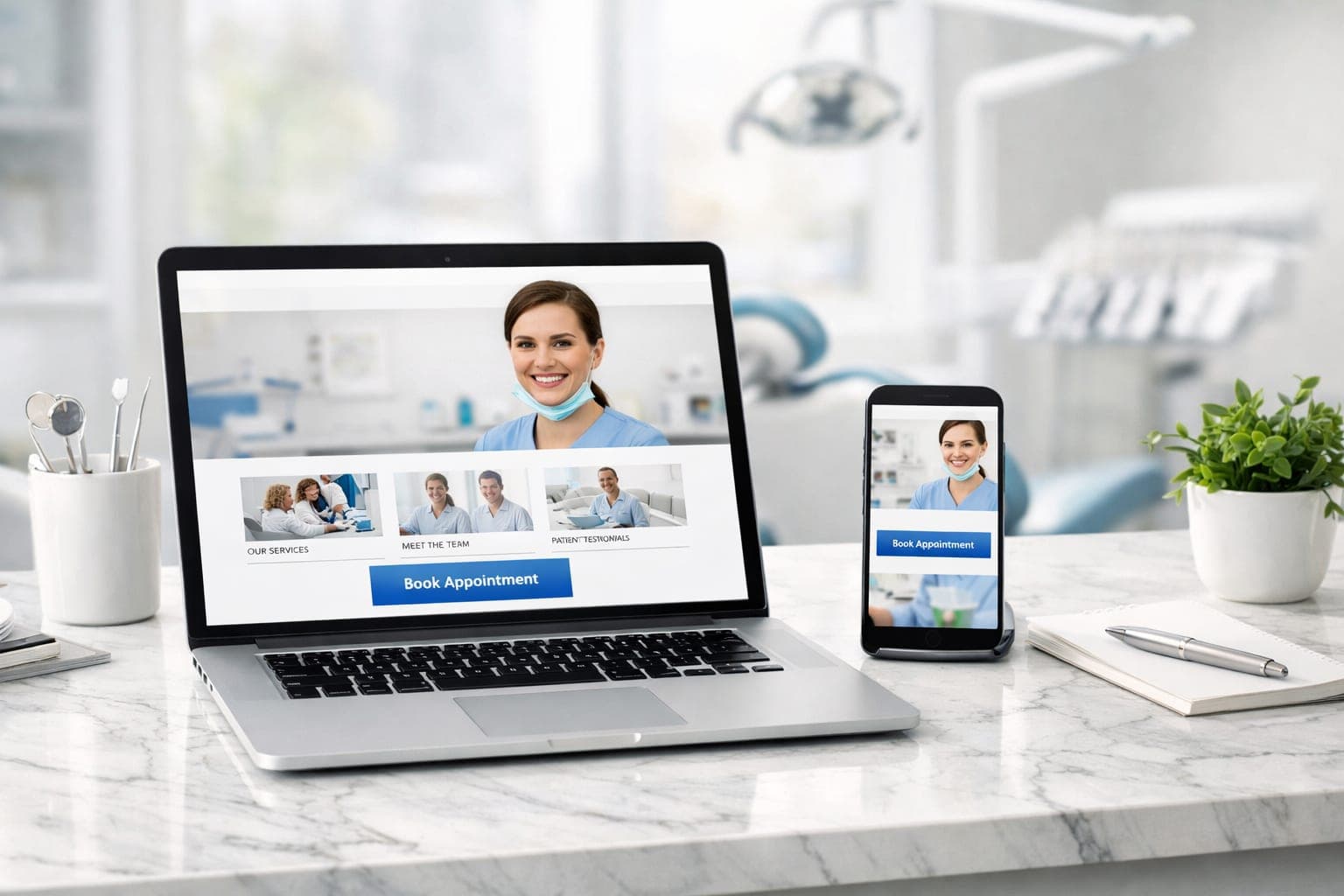
High-converting dental website design is not about flashy graphics or complex animations. It is about eliminating the hurdles between a patient feeling a toothache and that patient booking a spot in your chair. Your website is usually the first time a potential patient meets your practice, and if the experience is slow or confusing, they will find a competitor instead.
Key takeaways
- Your website has one primary goal: turning visitors into scheduled appointments.
- Dedicated service pages are essential for both dental SEO and patient conversion.
- Mobile optimization and fast load speeds are critical for capturing local leads.
- Trust is built through professional provider photos and clear insurance information.
What makes a dental website actually convert?
A practice website has one job: turn a visitor into a scheduled appointment. Every image, paragraph, and button needs to serve that goal. Most visitors are looking for three things immediately. Do you provide the service they need? Do you take their insurance? Can you be trusted? If your design hides these answers, you are losing money.
To achieve this, you need a strategic site structure. A patient should never be more than two clicks away from a booking page. A standard, high-performing structure includes:
- Home Page: A high-level overview that builds immediate trust.
- Service Pages: Individual pages for each treatment, such as implants, whitening, or Invisalign.
- About/Provider Pages: Professional profiles of your doctors and staff.
- Patient Resources: Insurance info, new patient forms, and FAQs.
- Contact Page: Your map, phone number, and a contact form.
Navigation becomes more complex if you have multiple offices. You must ensure a patient finds the location nearest to them without getting lost in a menu. Read our guide on Multi Location Dental Website Navigation to see how we use location-specific landing pages and smart routing.
When designing for conversion, you must consider the emotional state of the user. Many people visiting a dental site are in pain or feeling anxious about a procedure. A cluttered design with popping alerts and auto-playing videos increases that anxiety. A clean, minimalist layout with plenty of white space signals professionalism and calm, which encourages the user to take the next step.
How do I structure service pages for practice growth?
Do not list every service you offer on one long page. Each major treatment needs its own page for dental SEO and conversion. A dedicated page for dental implants, for example, lets you target specific keywords and speak directly to the fears of an implant patient.
Every service page should follow this conversion flow:
- Clear Headline: State the main benefit of the treatment.
- The Problem: Acknowledge the patient's pain or how they feel about their smile.
- The Solution: Explain how your practice handles the procedure.
- Social Proof: Use patient testimonials specifically for that treatment.
- Clear Call to Action (CTA): Put a booking button where it is easy to see.
For those running paid ads, a full website might be too much. In those cases, Dental Landing Page Design for High-Converting Campaigns can help you capture leads more efficiently by focusing on a single offer. If you specialize in specific high-value treatments, you might also look at our Teeth Whitening Landing Page structure to boost bookings.
Beyond the flow, the content must be "people-first." Google emphasizes helpful content that demonstrates expertise and experience. Instead of using medical jargon that confuses the patient, use plain language. Explain the "why" behind the treatment. For example, instead of just listing "periodontal scaling," explain how it saves the patient's natural teeth and prevents systemic health issues.
Building trust through UX for dentists
Patients do not buy a service; they buy a relationship with a provider. Generic stock photos of random people in white coats do not build trust. Use professional photos of your actual doctors and staff to humanize the practice.
Your bio pages should balance your credentials with your personality. Mention where you studied, but also why you love dentistry. This helps a nervous patient feel more comfortable before they ever set foot in your office. For a deeper look at these pages, see our Dentist Bio Page Website guide to learn how to lower patient anxiety through design.
The booking experience is the most critical part of the user experience (UX). Your booking button should have a contrasting color and be placed in the top right of the header and at the end of every service section. We have analyzed the best spots for growth in our article on Dental Website Booking Button Placement.
Once a patient clicks "Book Now," the experience must be fast. Avoid long, tedious forms that ask for a full medical history on the first screen. Instead, use a multi-step process: capture the lead first, then ask for the details. If you use online forms to collect health data, you must use HIPAA-appropriate tools to protect patient privacy. To fix this flow, read our guide on Online Patient Forms Dental Clinics to increase your conversion rates.
Trust is also built through transparency. Including a "What to Expect" section for new patients can significantly reduce the barrier to booking. When patients know exactly where to park, what the check-in process looks like, and how the first consultation is handled, the perceived risk of booking decreases.
Mobile performance and patient acquisition
Most patients search for a dentist on their phone. A mobile-friendly design is not a luxury; it is a requirement for patient acquisition. This means buttons are large enough to tap, text is readable without zooming, and the phone number is click-to-call.
Page speed is also a major ranking factor. Google uses Core Web Vitals to measure how quickly your page loads. A slow site leads to high bounce rates, meaning patients leave before the page even loads. If your mobile experience is lagging, check our Mobile Friendly Dental Website guide to stop losing patients to slow load times.
Mobile users have different intents than desktop users. A desktop user might be researching the difference between veneers and crowns. A mobile user is often looking for a phone number or a map because they are on the go. Your mobile design should prioritize these "action" elements. The "Call Now" and "Book Now" buttons should be persistently available, perhaps in a sticky footer, so the user does not have to scroll back to the top.
If you are struggling with a slow site or a layout that looks broken on iOS and Android devices, GenXTech Solutions can build you a high-performance site. Our team specializes in the intersection of clinical aesthetics and technical performance.
Integrating dental SEO into your design
Your design must work in tandem with your dental SEO strategy. To show up in the "Map Pack," your site needs to tell search engines exactly where you are located.
- Use LocalBusiness structured data to give Google your exact address and hours. Your developer can handle this technical implementation. You can find the technical rules in the Google Search Central LocalBusiness guide.
- Ensure your Name, Address, and Phone number (NAP) are identical on your website and your Google Business Profile.
- Create a dedicated page for your city and neighborhood to catch local search traffic.
For a comprehensive approach to visibility, explore our Dental SEO Services for US Dental Practices or read the Local SEO for Dental Clinic Growth guide to get more new patients. If you are new to the process, the Dental SEO Guide provides a roadmap for choosing the right growth partner.
SEO is not just about keywords; it is about the architecture of your information. Internal linking helps Google understand which pages are the most important. By linking from your home page to your primary service pages, you pass "authority" to those pages, making them more likely to rank for high-value terms like "emergency dentist near me."
Furthermore, your meta titles and descriptions are your "organic ad copy." They are the first thing a patient sees in search results. Following the Google Search Central guide on page titles ensures your titles are not truncated and clearly communicate your value proposition.
Essential content that stops patient leak
Two areas most clinics overlook are hours and insurance. A patient will leave your site immediately if they cannot tell if you are open on Saturdays or if you accept their PPO plan.
Do not bury this information in a PDF. Put it in plain text on a dedicated page or in the footer. Our guide on Dental Website Hours & Insurance shows you how to present this data so you stop losing new patients.
Additionally, first impressions happen in seconds. To ensure you are winning patients the moment they land on your page, check out our article on Clinic Website First Impression.
Another common leak is the lack of "Before and After" galleries. For cosmetic dentistry, patients need visual proof of your skill. However, these galleries must be designed carefully. Large, unoptimized images will kill your page speed. Use a gallery plugin that implements lazy loading, ensuring images only load as the user scrolls down.
If you also offer aesthetic services, you can apply similar logic to Med Spa Website Design or use our Med Spa Before and After Website Tips to maximize the impact of your visual results.
Accessibility and legal compliance
Your website must be accessible to everyone, including people with visual or motor impairments. Following the Web Content Accessibility Guidelines (WCAG) is a best practice and is often a legal requirement under the ADA.
Simple ways to improve accessibility include:
- High contrast between your text and background colors.
- Alt text for all images so screen readers can describe them.
- Menus that can be navigated using a keyboard.
- Avoiding the use of color alone to convey meaning (e.g., "click the red button").
Beyond technical accessibility, you must be mindful of the FTC guidelines regarding testimonials. Ensure your patient reviews are genuine and that any paid endorsements are clearly disclosed. This protects your practice from legal scrutiny and maintains the trust you have built with your audience.
When to redesign versus maintain
You do not need a full overhaul every year. However, if your conversion rate drops or your branding changes, you need a redesign. Be careful during this process. You risk losing your SEO rankings if you change URLs without a proper redirect plan.
Read our Dental Website Redesign SEO Guide to learn how to refresh your look without losing your rankings. Once the site is live, the work continues. Plugins need updates, backups must run, and content needs to stay fresh. To understand the operational side, see Website Maintenance for Dental Practice.
A redesign is also a great time to audit your content. Remove outdated services and expand on the ones that drive the most revenue. If you have noticed a surge in interest for a specific treatment, create a new, high-converting landing page for it. For example, if you are expanding your med spa offerings, you might need a How to Build a High-Converting Botox Landing Page or a Med Spa Membership Website Page to capture that specific market.
Choosing a design partner for your practice
Many clinics make the mistake of hiring a general agency that works with law firms and bakeries. Dental practices have specific needs, such as HIPAA considerations and a heavy focus on local leads.
When looking for a provider, check if they can integrate your booking software and if they understand patient psychology. Ask them how they handle local SEO and whether they provide ongoing maintenance. A site that is not updated is a site that will eventually break or become a security risk.
For a breakdown of costs and contract tips, see our Dental Web Design Buyers Guide or the broader Dental Marketing Guide. If you are looking for specialized services in other regions, such as Clinic Website Design Singapore, ensure the agency understands the local regulatory environment.
Finally, ensure your partner understands the difference between a "pretty" website and a "performing" website. A site that wins design awards but does not generate appointments is a failure for a business owner. Your partner should be talking to you about conversion rates, lead volume, and cost per acquisition, not just color palettes and fonts.
Next step
Your website should be your hardest working employee. It should bring in new patients while you focus on clinical care. If your current site is just a digital brochure instead of a booking machine, it is time for a change.
Contact GenXTech Solutions for a professional practice website or high-converting treatment pages.
Frequently asked questions
How often should a dental practice update its website?
Content and offers should be updated monthly to stay relevant. A full visual and UX redesign is typically recommended every 3 to 5 years to keep up with design trends and mobile technology.
Do I need a separate page for every dental service I offer?
Yes. Dedicated service pages allow you to optimize for specific search terms like 'dental implants in [City]'. They provide the detailed information patients need to feel confident booking that specific treatment.
Is a booking button better than a contact form?
A booking button that integrates with your practice management software is superior because it reduces friction. However, a simple contact form remains useful for general inquiries or insurance questions.
Does my dental website need to be ADA compliant?
Yes. Following WCAG guidelines ensures that people with disabilities can access your services. This is not only a best practice for UX but also helps protect your practice from legal risks.
How does page speed affect my patient acquisition?
Slow load times lead to higher bounce rates, meaning potential patients leave before seeing your offers. Fast sites rank better in search results and provide a professional first impression.